ASUU: Education Funding Critical To Research, Global Competitiveness
The Academic Staff Union of Universities has called for stronger and sustained investment in education, saying adequate funding is critical to improving research, strengthening public universities and positioning Nigeria to compete in the global knowledge economy.
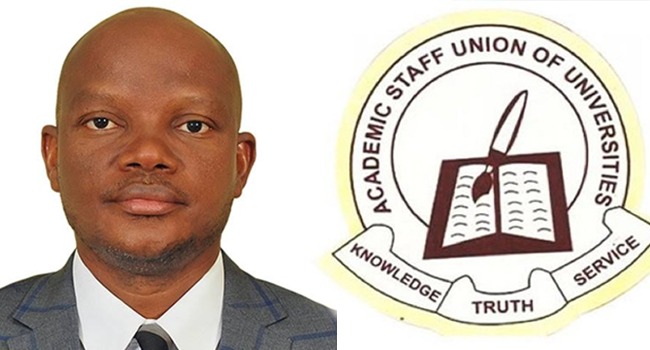
The ASUU President, Professor Christopher Piwuna, made the call on Wednesday during an interview on Eagle 102.5 FM’s Frontline, where he discussed the implementation of the December 2025 agreement between the Federal Government and the university lecturers’ union.
Piwuna said governments should work towards dedicating up to 26 per cent of their budgets to education, describing funding as a necessary investment in the development of the sector rather than an expenditure that could be continually reduced because of competing demands.
26% Benchmark, 15% Compromise
According to him, ASUU had pushed for the 26 per cent benchmark but eventually reached a compromise with the Federal Government on 15 per cent, acknowledging the financial challenges involved in meeting the higher target.
He said the compromise was reached on the understanding that increased funding would remain central to improving education and that government would progressively work towards providing the resources required by the sector.
“Every government should at least aim to supply or to fund their budget or dedicate their budget up to 26 percent to education, and Nigeria is not an exception,” Piwuna said.
He added that while ASUU had agreed to the 15 per cent figure with the government, the union believed the target could be pursued incrementally.
Research Funding and University Development
Piwuna also linked education funding to research, saying the December 2025 agreement contained provisions intended to address some of the structural challenges confronting public universities.
“The agreement, when we signed it, had provision for funding for public universities. It had provisions for improved salary, and it had provision for research council, amongst others,” he said.
He said stronger investment in research would be necessary if Nigerian universities were to contribute effectively to national development and produce knowledge capable of competing beyond the country.
Government Agreements and University Stability
The ASUU president said the funding question was also connected to the implementation of agreements reached between the union and government.
He expressed disappointment that the union was still discussing unresolved aspects of the December agreement months after it was signed, saying ASUU had expected the pact to move the university system away from recurring disputes towards stability and development.
“It’s really painful to have conversation on issues like this. Our expectation, when we signed an agreement in December 2025, was that we are going at this time to talk about progress that we have made to stability in the system and concern ourselves with issues that affect Nigerians,” he said.
Piwuna said inconsistent implementation had continued to affect universities, including salary payments and the application of the new salary structure.
“As we stand now, funding is not properly being done according to what was agreed to. Individual universities have to embark on strike before salaries are being paid. Some universities are cut off from the new salary structure,” he said.
Federal, State Governments Share Responsibility
He said responsibility for improving university education could not rest solely with the Federal Government, noting that state governments also have significant roles because of the number of state-owned universities across the country.
Piwuna said ASUU had continued to engage government officials over the implementation of agreements, including the Minister of Education and the chairman of the committee monitoring implementation of the Federal Government agreement, Senator Larry Tejuosho.
“We have engaged them; the Minister of Education at federal level, we engaged Senator Larry Tejuosho, the chairman of the implementation committee monitoring of the Federal Government agreement. We have reminded them to do the needful,” he said.
Education as a National Development Priority
Piwuna further urged political leaders to treat education as a long-term national development priority, arguing that the consequences of underinvestment extend beyond universities to research, innovation, human capital and the wider economy.
“We all know the value of education and we expect our leaders to carry out policies and actions that will promote education,” he said.
He said sustained funding, proper implementation of agreements and greater attention to research would be necessary to create a university system capable of meeting Nigeria’s development needs.
The ASUU president’s comments come amid renewed concerns over the implementation of the December 2025 agreement, including salary-related issues and other outstanding commitments raised by the union.
For ASUU, the funding debate therefore extends beyond the immediate welfare of lecturers, touching on the capacity of Nigerian universities to conduct research, retain academics, develop knowledge and contribute to the country’s competitiveness in an increasingly knowledge-driven global economy.
You can get every of our news as soon as they drop on WhatsApp ...To get all news updates, Join our WhatsApp Group (Click Here)