Reasons Oyo Zone Should Produce The Next Oyo State Governor
The need for equity requires good and equitable allocation of political assets, especially where all components are considered equal. Failure to adhere to this principle can stir intellectual and sociological oppression from the ‘oppressed’, a dynamic now evident in Oyo State.
Oyo State, the “Pace Setter State,” is a pivotal political and economic entity in South-Western Nigeria. Its rich history, intertwined with the Old Oyo Empire, boasts a diverse population, including Ibadans, Ibarapas, Oyos, Oke-Oguns, and Ogbomoso This mosaic necessitates a governance structure fostering unity and equitable representation.
In Nigerian politics, an unwritten yet widely accepted convention of power rotation, or “zoning,” shapes outcomes. Though not formally in the 1999 Constitution, this practice, even formalized by parties like the PDP, promotes inclusivity, fairness, and balanced representation among diverse groups.
This adherence highlights Nigerian political pragmatism: preventing perpetual power concentration and avoiding marginalization and instability. Advocating for an Oyo North gubernatorial candidate is thus an appeal to this deeply ingrained mechanism for harmony and collective ownership.
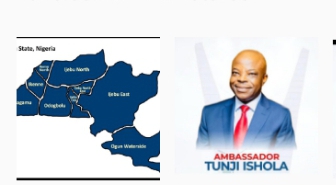
Oyo State is divided into zones, which is fundamental to the state’s political architecture, influencing resource allocation, legislative representation, and power distribution. Understanding their composition is essential for appreciating political dynamics and historical leadership patterns.
The Oyo zone, or better still, Oyo Federal Constituency is an important geographical and demographic entity, encompassing a portion of Oyo State. It comprises four local government area zones.
Since Nigeria’s return to democratic governance in 1979, Oyo State has been led by several democratically elected governors. A sequential examination of their origins reveals a striking pattern: a persistent concentration of power within a specific zone.
The first civilian governor, Chief Bola Ige (UPN, Oct 1, 1979 – Oct 1, 1983), though born in Esa Oke (now Osun State), had his political base firmly in Ibadan, placing his political center of gravity within Ibadan zone. Following Chief Ige, Dr. Victor Omololu Olunloyo (NPN, Oct 1, 1983 – Dec 31, 1983) was born in Ibadan, situating him within the zone. His tenure was cut short by a military coup.
The Third Republic saw Chief Kolapo Olawuyi Ishola (SDP, Jan 2, 1992 – Nov 17, 1993) serve as governor. Like his predecessors, Chief Ishola was born in Ibadan, firmly placing him in the zone. His term also ended prematurely due to military intervention.
With the Fourth Republic in 1999, Dr. Lam Adesina (AD, May 29, 1999 – May 28, 2003) became governor. Dr. Adesina was born in Ibadan, thereby originating from the zone. His successor, Senator Rashidi Adewolu Ladoja (PDP, May 29, 2003), the Olubadan of Ibadan, was born in Gambari, Ibadan, and had previously represented the Oyo South Senatorial District as a Senator. His governorship experienced significant political turbulence, including a controversial impeachment (Jan 12, 2006) later nullified and overturned, leading to his reinstatement (Dec 7, 2006), serving until May 28, 2007.
It is within this context that Christopher Adebayo Alao-Akala’s governorship presents unique circumstances. Following Governor Ladoja’s impeachment, Alao-Akala assumed the de facto governorship (Jan 12, 2006 – Dec 7, 2006). This interim period was characterized by political unrest, and his ascension was a direct consequence of the controversial, ultimately illegal, impeachment. Subsequently, after Ladoja’s reinstatement, Alao-Akala successfully contested and won the gubernatorial election in 2007 under the PDP, serving a full term (May 29, 2007 – May 29, 2011).
Alao-Akala was born in Ogbomoso, Ogbomoso, north Local Government Area, part of the Oyo North Senatorial District.
While he served a full elected term, his initial rise was not a direct electoral mandate but a consequence of a political crisis. This historical anomaly underscores the difficulty Ogbomoso has faced in producing a governor through conventional, uninterrupted political pathways from the outset of a term.
Senator Abiola Ajimobi (ACN, later APC) served two consecutive terms (May 29, 2011 – May 29, 2019), the first governor in Oyo State to achieve this. Senator Ajimobi was born in Oja’ba, Ibadan, and had previously represented the Oyo South Senatorial District, firmly placing him within the Ibadan zone. The incumbent governor, Engineer Seyi Makinde (PDP), assumed office on May 29, 2019, and was re-elected in 2023. Governor Makinde was born in Oja’ba, Ibadan, originating from the Oyo South Senatorial District.
A sequential review of all democratically elected governors reveals a striking and enduring pattern: with the singular exception of Christopher Alao-Akala’s elected term, every other governor originated from Ibadan.
Even Chief Bola Ige, though born in what is now Osun State, had his primary political base in Ibadan. This consistent concentration of gubernatorial power within the Ibadan bloc signifies a deeply entrenched imbalance. For over four decades of democratic governance, only one governor has emerged from Oyo North, and even that instance was initially triggered by an extraordinary political event rather than a conventional, uninterrupted electoral cycle for his first term.
This suggests a systemic imbalance, where the principle of rotational justice, frequently invoked in Nigerian politics, has largely been overlooked or under-applied in the context of Oyo State’s highest office.
The Old Oyo National Park is located in the historical site of the ancient capital of the famous Old Oyo Empire. The Oyo Empire itself was a powerful Yoruba empire with a rich history of commerce, architecture, and cultural diversity.
A governor from Oyo Zone would send a powerful message of inclusion and equity, potentially diffusing latent regional grievances and strengthening the social fabric of the state, thereby contributing to long-term political stability and a more harmonious political environment. By consciously deciding to zone the governorship to the Oyo zone, political stakeholders in Oyo State can proactively demonstrate a commitment to inclusive governance.
This decision would serve as a powerful precedent, indicating that merit and capacity are recognized across all regions, and that the state is truly committed to a balanced developmental agenda; it goes beyond mere rhetoric to tangible action.
The emergence of a governor from the Oyo zone would signify a new era of inclusive governance, where the unique strengths and needs of every senatorial district are recognized and leveraged for the collective good. This strategic move promises not only to address historical imbalances but also to foster balanced development, strengthen inter-district harmony, and ensure a more prosperous and united future for all citizens of Oyo State.
You can get every of our news as soon as they drop on WhatsApp ...To get all news updates, Join our WhatsApp Group (Click Here)