Who Has The Subsidy Removal Helped? Sowore Questions Tinubu’s Reform Claim
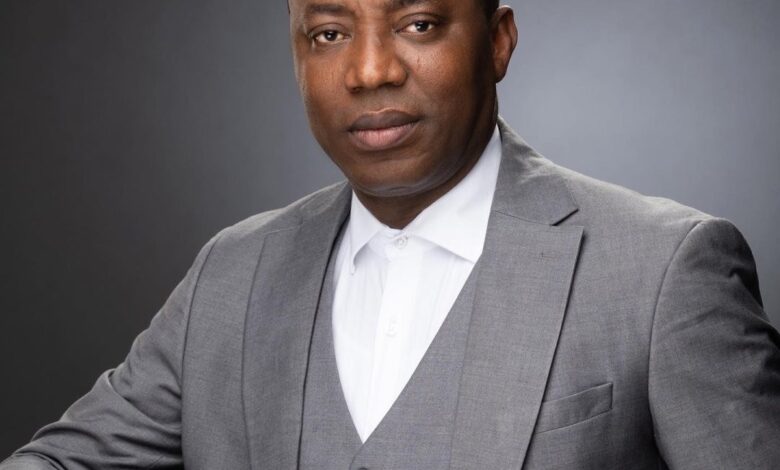
Human rights activist and former presidential candidate of the African Action Congress (AAC), Omoyele Sowore, has questioned the effectiveness of the federal government’s fuel subsidy removal, arguing that the policy has deepened economic hardship rather than delivering relief to Nigerians.
He stated that the reform has not translated into improved living conditions, insisting that ordinary citizens have borne the brunt of the policy shift. According to him, the promise that subsidy removal would strengthen infrastructure and improve welfare has not materialised.
Speaking on Thursday, during an exclusive interview on Frontline, a current affairs programme on Eagle 102.5 FM, Ilese Ijebu, Ogun State, the Publisher of Sahara Reporter, Sowore where he strongly criticised the current administration’s economic direction.
He maintained that the value of the naira has collapsed significantly under the present government, describing it as evidence of economic mismanagement. He also argued that inflation, borrowing, and wage stagnation have worsened under the policy framework introduced by the administration.
He said, “Well, the economic situation in the country is transparent to all of you. It’s not something that you need an expert analyst to tell you. Like the government from day one of its inception mismanaged the Nigerian economy. And how do you know? The strength of your currency is one of the ways you judge your economic relevance and your purchasing power. It went from 400 Naira that Tinubu met in Naira, to a dollar. And now we are now at 1,400 or 450, as the case may be, or 1,500.”
Sowore further argued that the removal of subsidy was accompanied by promises that have not been fulfilled, stressing that citizens have not seen any improvement in infrastructure or social services. He said the policy has instead increased hardship across households and small businesses. He maintained that the economic burden has shifted directly onto the population without adequate cushioning mechanisms.
He stated, “He removed what he called subsidy and lied to all of you that the removal of subsidy will lead to more prosperity, that he will invest the money in building roads and securing your neighborhoods and securing your schools, and he will somehow give you more money in your pocket. Ask yourself, has that happened? So all of you are vanquished economically.”
Sowore also accused the government of relying heavily on borrowing to sustain basic governance functions, including salary payments. He argued that such borrowing reflects deeper structural weaknesses in the economy. He claimed that multiple ministries are now operating with little or no capital allocation, which he described as evidence of systemic failure.
He said, “We have engaged, or he has engaged in borrowing money that has never been done before. They are borrowing money to pay salaries. They are borrowing money to do everything. The Nigerian economy can’t even fulfill its obligations to its lawful budget. So you have several ministries that get zero capital revenues for their ministries. So what economy are you talking about?”
He insisted that there is no meaningful economic progress to evaluate under the current arrangement, adding that citizens are struggling with rising costs of living. According to him, the situation has pushed many Nigerians into extreme financial distress, with basic survival becoming difficult.
Sowore said, “There is no economy here anymore. People are just living from hand to mouth. A lot of people can’t even lift their hand to mouth anymore. That’s where we are. So there’s nothing to evaluate economically about this Tinubu regime.”
He dismissed arguments that subsidy removal was necessary to prevent national bankruptcy, insisting instead that Nigeria is already economically compromised. He argued that the policy has only worsened living conditions without delivering measurable benefits to the public.
He stated, “It wasn’t. No. Nigeria has gone bankrupt since removal of subsidy. How do you know you’re bankrupt? Because you can’t even fulfill basic obligations.”
Sowore explained that subsidy, in principle, is meant to support vulnerable populations, but argued that in Nigeria, it has been mismanaged through diversion and elite capture. He said the real issue is not subsidy itself but its misapplication by those in power.
He said, “As I have always said, the problem with subsidy is that you have an application of funds meant to support the vulnerable society, you know, basically. And you don’t let the people get it. You instead apply and divert it to your friends. And then you blame the people who are supposed to benefit from the subsidy.”
He questioned the effectiveness of removing subsidy on petrol alone while other sectors remain unaffected, arguing that the policy disproportionately impacts small businesses and ordinary citizens. He maintained that the economic consequences have been widespread and severe.
Sowore said, “So the question is, since you took subsidy away from the people, and the only thing we’re talking about here is that of all the petroleum providers, we’re only subsidizing one, which is gasoline. Petrol, as we call it.”
He argued that the removal has benefitted only a small elite group while worsening inflation and insecurity. He linked economic hardship to rising criminality, stating that poverty creates conditions for instability.
He said, “I ask again, who has benefited from the removal of subsidy? If you know anybody, please point them to me. Apart from the 1% people who dominate the political and economic stage.”
Sowore further argued that no country operates without forms of subsidy, insisting that welfare support systems exist globally in different forms. He compared Nigeria’s situation unfavourably with developed economies.
He said, “Let me tell you, so that you know this, there is no country in the world, none with that exception, that don’t subsidize their citizens either in the health sector, either in the education sector.”
He added that even in advanced economies, citizens benefit from structured welfare systems such as unemployment benefits and tax credits, which he says Nigeria lacks.
He stated, “People in Europe, America, you just arrived, you don’t even have any status. You benefit from subsidies. I have benefited before in the US from unemployment allowances. I got food stamps before.”
CALLER INTERVENTION
CALLER 1
“Yes, my name is Abdulwasiu calling from Ago Iwoye. We appreciate our guest and his effort since 1992. It is a human right, and we believe in him. But one thing I would advise him is that he needs to work with the opposition. One political party cannot deliver Nigeria this time around. All the political parties need to come together so that they can rescue Nigeria from insecurity. They can rescue Nigeria from economic woes where a common man cannot buy a tube of yam. A situation where a common man cannot make a transport from Lagos to Calabar because the transport is too costly. Very, very. Nobody is enjoying the country presently. I must confess to you. Let’s come together and do the needful. Nigeria belongs to all of us..”
CALLER 2
“PHLLIPS: He was asking that there was a time former head of state, abubakar said if you becomes the president, everyone, every political figure in the country will run away. He’s asking, you know, are they scared of you, what it is.”
SOWORE’S RESPONSE TO CALLERS
Sowore responded by rejecting the idea of relying on elite political coalitions, insisting that meaningful change must come from a different structure of mobilisation. He argued that existing political alliances are made up of recycled elites who have all participated in governance failures. He maintained that citizens should not expect transformation from the same group of leaders who created current problems.
He said, “There’s a vibrant population out there that can form a coalition of the oppressed. You don’t need your oppressors to be in another coalition, because they can never save you.”
He also dismissed concerns about political fear or intimidation, stating that his movement is based on accountability rather than personal ambition. He argued that resistance to his activism reflects fear of losing privilege rather than fear of him personally.
He stated, “I’m not scaring them away. But they know based on my antecedents that we will not have a country where the tribe and the rest of us will not thrive.”
Sowore maintained throughout his position that subsidy removal has not benefited the wider population and instead deepened inequality.
He insisted that economic policy must be judged by its impact on ordinary citizens rather than macroeconomic indicators alone. He argued that Nigeria’s current direction reflects elite protection rather than public welfare.
He concluded that until systemic restructuring is achieved, economic hardship will persist, and citizens will continue to bear the consequences of policy failures.
You can get every of our news as soon as they drop on WhatsApp ...To get all news updates, Join our WhatsApp Group (Click Here)